Restoration certifications & industry associations
A water-loss contractor, fire-restoration specialist and mold-remediation supervisor do not necessarily need the same qualifications. Learn what common restoration credentials cover, who actually holds them, and how to check the claims made by companies in our directory.
Sources reviewed .
This is an independent educational resource, not an endorsement or a complete credential audit of every directory company. A company website claim is not the same as issuer verification. Credentials, staffing and membership can change; verify the exact office and assigned professional before hiring.
Understand the qualification before comparing the company
Business certification · Institute of Inspection, Cleaning and Restoration Certification
IICRC Certified Firm (IICRC)
A business-level designation, separate from an employee's technical certifications.
The IICRC Certified Firm program concerns the business, not just a course attended by one employee. The issuer's application identifies an active IICRC-certified technician and current liability insurance among its requirements. That distinction matters when a contractor's advertising says only that its team is trained or certified.
For a property owner, firm status is a starting point for verification rather than a substitute for a project-specific discussion. Match the legal business name and office to the IICRC locator, then ask which appropriately qualified technician will supervise the work. A franchise brand's reputation does not establish the status of every independently operated location.
Ask before hiring: What is your Certified Firm name or number, and which current technician certifications are relevant to my loss?
Important limit: Firm status does not mean every employee holds every IICRC specialty, or that a particular outcome or insurance payment is guaranteed.
Water-loss assessment, contamination awareness and the fundamentals of restorative drying.
WRT addresses how water affects building materials and the procedures used in water-loss remediation. Its scope includes understanding drying techniques, sewer backflows and contamination issues. The credential belongs to a person; a website stating that a company has WRT technicians should not be read as proof that all staff have earned it.
After a supply-line break, appliance overflow or basement water intrusion, ask how the team will locate affected materials, document initial conditions and decide what can be dried rather than removed. The useful conversation connects training to moisture measurements, a written scope and progress records, not simply the number of drying machines delivered.
Ask before hiring: Who is the WRT-qualified person responsible for assessment, and how will you document moisture and drying progress?
Important limit: WRT alone is not evidence of structural engineering, asbestos authorization or every mold-remediation qualification.
Applied drying strategies for water-damaged structures and contents.
ASD builds on WRT and focuses on effective drying within a restorative drying environment. The IICRC identifies WRT as a prerequisite. This is a more specific qualification than a general statement that a contractor performs water extraction, because drying decisions depend on material assemblies, environmental conditions and occupant safety.
For wet walls, flooring systems or a multi-room loss, ask the assigned professional to explain drying goals and how monitoring will inform equipment adjustments. Some materials cannot be restored safely or economically. A thoughtful drying plan identifies the reason for removal as well as the conditions needed to retain materials.
Ask before hiring: Will an ASD-qualified professional review the drying strategy, material decisions and completion criteria?
Important limit: ASD does not establish that every wet assembly can be saved or that a building is safe to occupy.
Fire and Smoke Damage Restoration Technician (FSRT)
Scoping, cleaning, deodorization and documentation after fire and smoke damage.
FSRT covers restoration work involving fire- and smoke-damaged structures and contents. The issuer's description includes mitigation, cleaning, deodorization and documentation, along with evidence-related topics such as subrogation and spoliation. These concerns differ from those of an uncomplicated clean-water incident.
Before cleaning starts, discuss how the company will identify affected rooms, preserve requested evidence and separate salvageable contents from items needing specialist evaluation. Ask how soot residues and odors will be addressed without representing a cosmetic improvement as proof that all hazards have been eliminated. Electrical, structural and other specialist clearances may be separate work.
Ask before hiring: Who holds FSRT, what will be documented before cleaning, and which safety evaluations require other professionals?
Important limit: FSRT is not a fire investigation license, structural safety approval or a guarantee of complete odor removal.
Mold and sewage remediation techniques, with worker and occupant protection.
AMRT addresses microbial remediation techniques rather than general building cleaning. IICRC lists WRT as a prerequisite and describes an emphasis on mold and sewage work. The distinction is useful when evaluating a contractor for contamination associated with persistent leaks, flooding or damaged porous materials.
Ask about the moisture source, containment approach, occupant protection and the criteria used to consider remediation complete. Whether an independent assessment, written protocol or post-remediation evaluation is needed depends on the project and local rules. The qualification of a technician should be checked separately from any state-required business or individual mold license.
Ask before hiring: Which AMRT-qualified person will supervise, and who will establish the scope and evaluate completion?
Important limit: AMRT does not replace a required mold license, independent assessment or medical advice about exposure.
Association membership · Restoration Industry Association
Restoration Industry Association membership (RIA)
Industry participation; distinguish membership from advanced professional designations.
RIA is a restoration industry association that also oversees advanced professional designations. Membership and certification are different claims. An association member is not automatically a Certified Restorer, Water Loss Specialist or holder of the other advanced designations. Conversely, RIA explicitly states that membership is not required for its certification.
When a contractor displays an association name, ask whether the membership belongs to the local business, a parent organization or an individual. If the proposal also names a professional designation, request that person's name and current credential. Keeping these categories separate makes comparison more useful than counting logos on a website.
Ask before hiring: Is this current membership for the contracting business, and does the assigned professional separately hold an RIA designation?
Important limit: Membership by itself is not proof of technical certification, government licensure or project-specific competence.
Certified Restorer and specialist pathways in water, contents, fire and environmental losses.
RIA's current advanced designation materials identify Certified Restorer (CR), Water Loss Specialist (WLS), Contents Loss Specialist (CLS), Fire Loss Specialist (FLS) and Environmental Risk Specialist (ERS). These are professional designations, not interchangeable descriptions of association membership. Ask about the exact designation rather than assuming that every RIA-related claim has the same meaning.
These qualifications can be relevant when a loss involves complex contents decisions, substantial water damage or coordination of several recovery disciplines. RIA describes continuing education and renewal obligations for certificants. Because pathways and requirements may change, use the issuer's current information rather than relying on an old training certificate or a generic badge.
Ask before hiring: Which named professional holds the relevant designation, is it current, and what role will they have on this project?
Important limit: Do not infer that a branch employs a designated professional because another office or the corporate group does.
Association membership · National Air Duct Cleaners Association
NADCA company membership (NADCA)
HVAC inspection, cleaning and restoration businesses; membership category and location matter.
NADCA's Regular Membership is for businesses performing air duct cleaning and calls for at least one Air Systems Cleaning Specialist on staff at each location. Other categories serve different purposes: an Associate Member may supply equipment or related services rather than perform cleaning. A membership claim needs its category and office context to be meaningful.
For HVAC cleaning after smoke, dust or water-related damage, compare the specific scope of the proposed system cleaning with the qualifications of the team assigned. Look for the actual company in NADCA's professional directory. A local member record is stronger evidence of that office's association relationship than an unrelated franchise logo.
Ask before hiring: Does the NADCA directory list this location, and which ASCS will oversee the HVAC cleaning work?
Important limit: NADCA membership is not a whole-building mold clearance, HVAC contractor license or proof of expertise in all restoration services.
An individual's knowledge and skills related to HVAC system hygiene.
NADCA states explicitly that ASCS certification applies to individuals, not companies, and is not transferable between people. It concerns air systems cleaning knowledge and skills. A statement that a company is ASCS-certified therefore needs clarification about the actual credential holder and their involvement.
After a property loss, ask whether the system needs inspection, cleaning, component replacement or evaluation by another specialist. A proposal should describe what is included and how inaccessible sections or damaged components will be handled. Confirming the credential is one part of evaluating that proposal, alongside scope, safety and documentation.
Ask before hiring: Who is the current ASCS responsible for this project, and how will their supervision be documented?
Important limit: An ASCS employed somewhere in a company does not establish that the same person will supervise your job.
Microbial remediation and remediation supervision.
ACAC's Council-certified Microbial Remediator (CMR) and Council-certified Microbial Remediation Supervisor (CMRS) are individual credentials. Its program describes verified field experience, examination, board approval and continuing professional development. The published scope includes containment, pressure relationships and remediation of affected materials.
For a substantial mold project, ask the named credential holder how remediation will follow the assessment or protocol and how surrounding spaces will be protected. Do not confuse a remediation credential with an independent assessment credential. Confirm local rules about licensing, role separation and who can perform any required evaluation.
Ask before hiring: Does the named remediator or supervisor hold current CMR or CMRS status, and what assessment governs the work?
Important limit: Certification alone does not authorize every regulated activity or replace state and local licensing requirements.
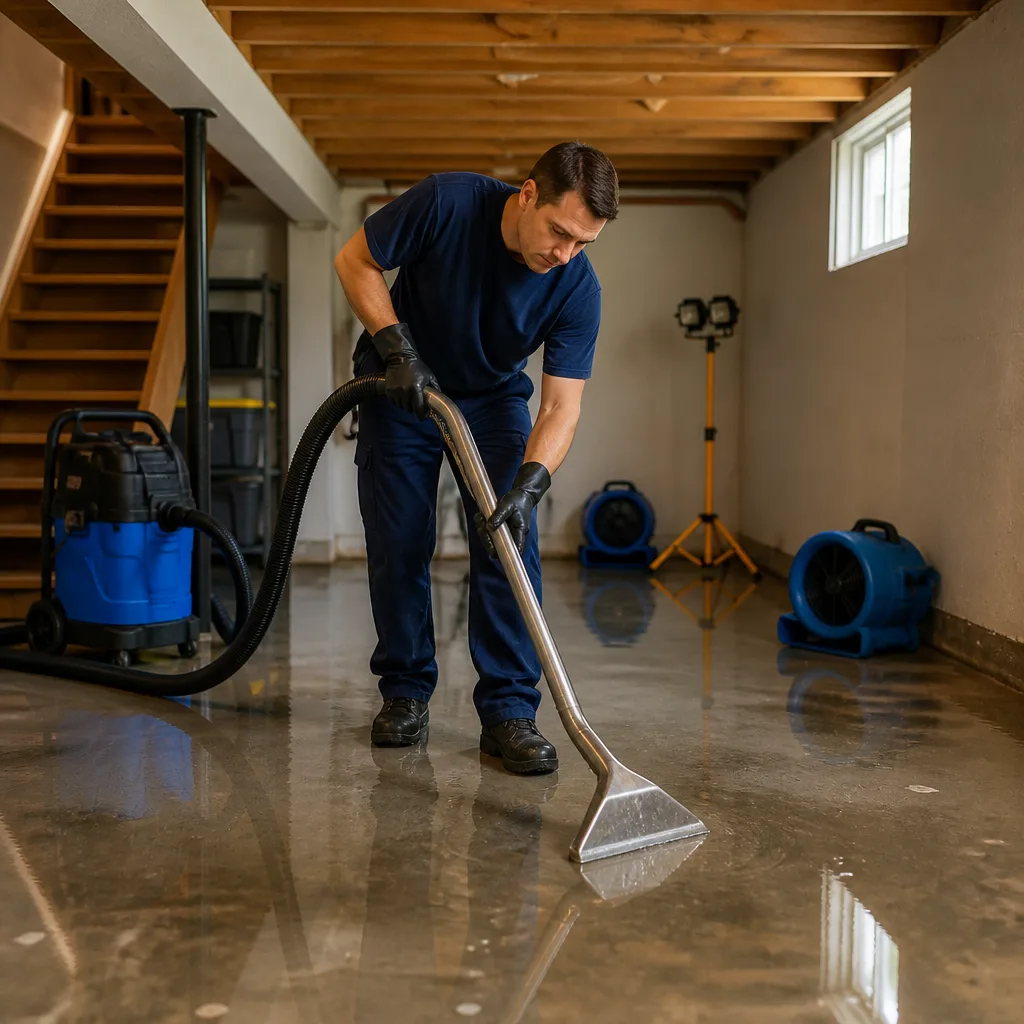
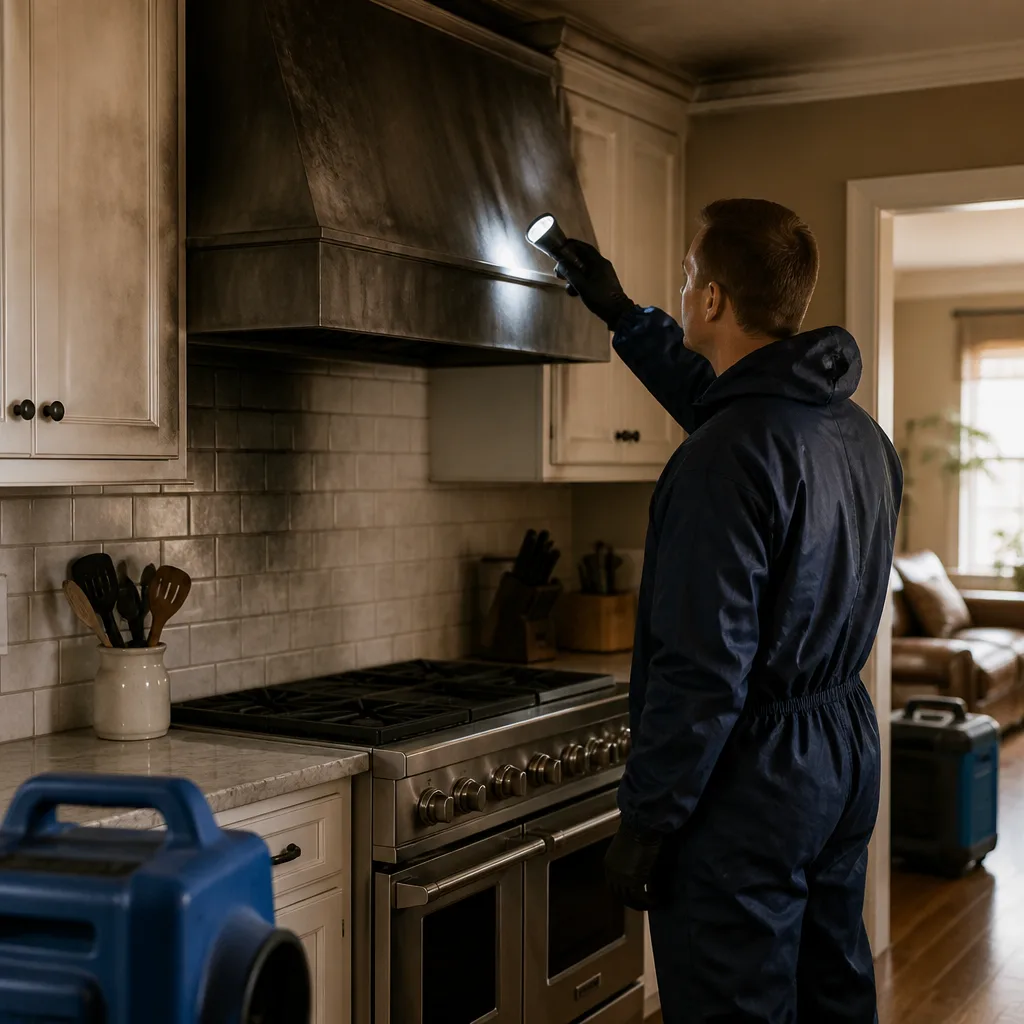
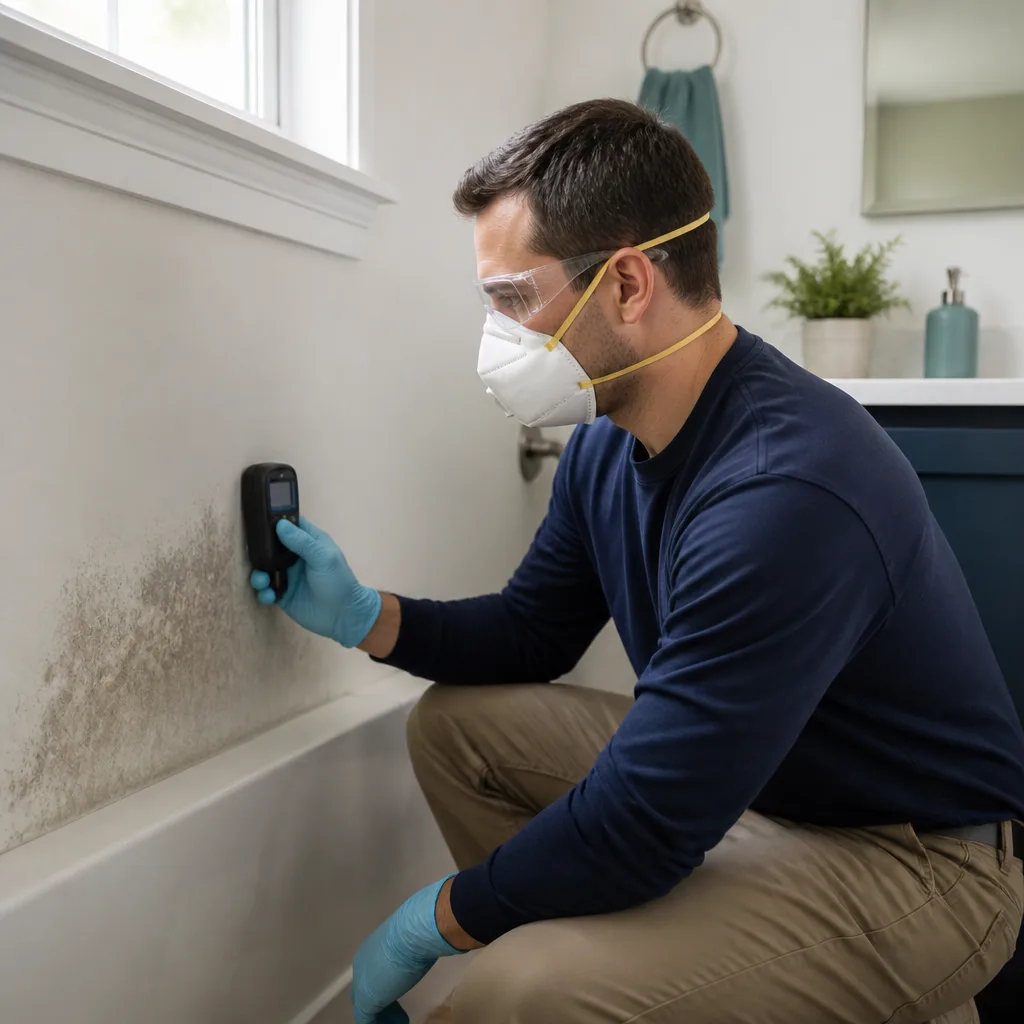
An illustrative restoration scene showing a technician extracting standing water in a residential basement. Generated illustrative imagery, not a listed company's project, credential holder or training event.An illustrative fire and smoke restoration scene in a residential kitchen. Generated illustrative imagery, not a listed company's project, credential holder or training event.An illustrative mold remediation inspection in a residential bathroom. Generated illustrative imagery, not a listed company's project, credential holder or training event.
Source-linked examples from listed companies
Issuer-directory records and company-published statements are different evidence types. The examples below are not a ranking or a complete audit. No record here should be read as proof of every specialty described above.
Grand Forks, North Dakota · Issuer directory record
NADCA's Steamatic of Grand Forks record lists the Grand Forks office, a member-since date and ASCS-certified personnel. The business website links to that same record. This evidence concerns that office, not every Steamatic location.
Recheck the issuer record and assigned ASCS before booking. This does not independently establish IICRC or RIA status.
The company's homepage describes Baystate as an IICRC-certified company. That is a business-published claim; the page does not provide the independent issuer confirmation needed to establish current Certified Firm status.
Ask for the firm record and the specialties of the team assigned. This page does not award Baystate a verified Certified Firm badge.
Albuquerque, New Mexico · Company-published statement
Bear Restoration's homepage publishes an IICRC Certified statement alongside its services. The statement does not identify a specialty or establish whether it refers to firm status, individual staff qualifications or both.
Request the exact credential holder and current issuer record. Do not infer WRT, ASD or AMRT from the general statement.
Newport News, Virginia · Company-published statement
The company's homepage describes IICRC-certified specialists. This supports reporting what the business says about its team, not independently assigning a specific technician certification or Certified Firm designation.
Confirm the named specialist, specialty and current status directly. Separate trade or contractor license claims require their own authority checks.
How to verify restoration credentials before signing
Match the exact business and office
Compare the legal name on the contract, local address and issuer record. Do not transfer a credential from a national brand or another franchise office.
Identify the person, not only the logo
Request the assigned supervisor's name, specialty, credential number where available and current status. Ask how that person will oversee the work.
Check the issuer directly
Use an official locator or contact the issuing organization. A website claim, course completion certificate or copied badge is not independent confirmation of active status.
Verify licenses and insurance separately
Check relevant state or local licensing authorities and request current insurance documentation appropriate to the scope. Certification does not replace legal authorization or prove insurance coverage for a particular loss.
Connect training to the written scope
Ask for the assessment, material decisions, containment or drying plan, progress documentation and completion criteria. Credential abbreviations should help explain who will perform those tasks.
Keep a dated verification record
Retain the issuer result or correspondence with your proposal and contract. Recheck when personnel, scope or the contracting entity changes; an old screenshot may no longer reflect current status.
Restoration certification questions
What certifications should a water damage restoration company have?
Look for qualifications relevant to the actual loss and the people assigned. IICRC WRT addresses water-damage fundamentals; ASD focuses on applied structural drying. IICRC Certified Firm is a separate business designation. Ask about current status, project supervision, required licenses, insurance and written drying documentation rather than treating one badge as a complete hiring decision.
Is an IICRC-certified technician the same as an IICRC Certified Firm?
No. A technician holds individual technical certifications. Certified Firm is a separate designation for a business whose application includes an active certified technician and current liability insurance. A company saying it employs certified technicians is not enough to infer Certified Firm status.
Does RIA membership mean someone is a Certified Restorer?
No. RIA membership and professional designations are separate. Certified Restorer and RIA specialist designations belong to qualified individuals. RIA also states that membership is not required for certification. Verify both the exact membership claim and any named professional's current designation.
Does NADCA certify companies or individual air duct cleaners?
ASCS is an individual certification, not a company certification. NADCA also has company membership categories. Its Regular Membership calls for an ASCS on staff at each location. Check the member business and the actual person responsible for your HVAC cleaning project separately.
Are all companies in this directory credential-verified?
No. Directory inclusion does not certify or endorse a company. This page identifies a limited set of source-linked examples and distinguishes issuer-directory evidence from company-published statements. Other profiles may have qualifications not yet documented here; absence from this page is not evidence that a business lacks credentials.
Can certification replace a state mold or contractor license?
No. Private certifications, association memberships, government licenses and insurance serve different purposes. Requirements depend on the jurisdiction and scope, including remediation, assessment, asbestos, lead, reconstruction and regulated trades. Confirm the rules with the relevant authority and verify the contractor's authorization for your specific work.